Why Discomfort Isn’t Always a Warning Sign: What Swing Dance Lessons Taught Me About Growth, Self-Trust, and Identity
At 56, I’m voluntarily becoming a beginner again.
A few weeks ago, I signed up for swing dance lessons.
Not private lessons.
Group lessons.
Which meant walking into a room alone where I didn’t know anyone, didn’t know what I was doing, and would almost immediately be rotating dance partners with strangers.
Honestly, I almost talked myself out of going multiple times before that first class.
Not because I didn’t want to dance.
Because I felt uncomfortable.
The unfamiliarity.
The lack of control.
The awkwardness.
The thought of being watched while not being good at something.
And what fascinated me most was realizing how quickly my brain interpreted that discomfort as a warning sign.
Maybe I shouldn’t go.
Maybe this isn’t for me.
Maybe I’ll look stupid.
Maybe everyone else already knows what they’re doing.
But I went anyway.
That first class was mostly:
“I’m uncomfortable… but willing.”
I overthought every step.
I worried about looking awkward.
I stayed in my head trying to “get it right” instead of relaxing into the experience.
And then came the partner rotations.
Every few minutes, we switched dance partners.
For someone who likes competence and control, this was… not ideal.
But I kept showing up.
Week two felt slightly different.
I noticed moments where I relaxed enough to think:
“Oh… I could actually see how this becomes fun once it feels more familiar.”
Week three, I started loosening up more.
I stopped taking myself quite so seriously.
I started laughing at myself.
Cracking jokes in class.
Realizing nobody cared if I missed a step.
And by week four, something shifted.
We were learning jitterbug with Charleston kicks, facing our partners and kicking between each other’s legs while trying not to collide with other couples on the dance floor.
Objectively, this should have felt ridiculous.
Instead, I was genuinely having fun.
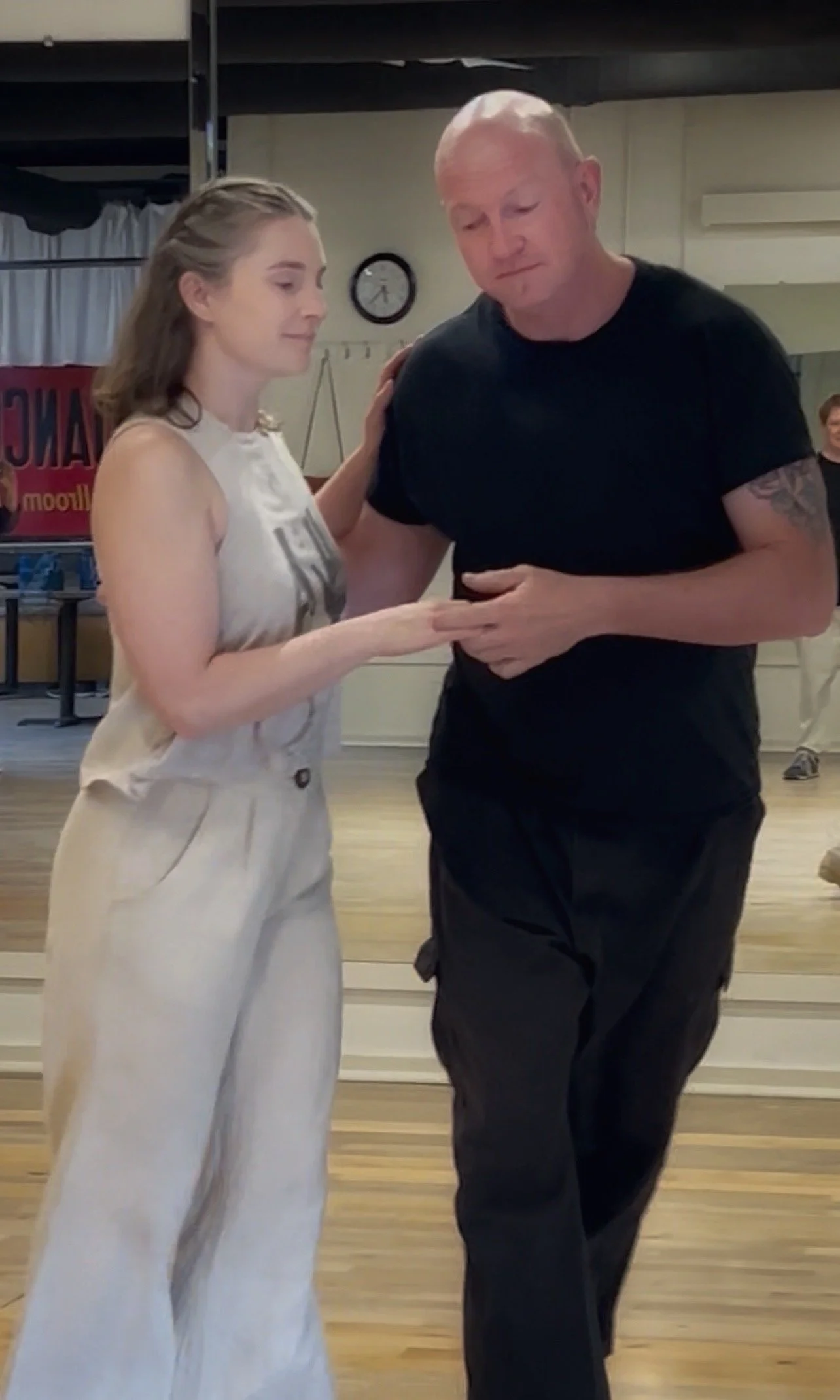
These are my dance instructors, Elli & Mike.
You can can check out their Santa Fe dance studio here: Studiocinco.org
And somewhere in the middle of all of this, I realized something important:
For a long time, I unconsciously equated competence with safety.
If I was good at something, I felt secure.
If I wasn’t good at something, my nervous system interpreted it as danger.
I see this constantly with high-achieving women law firm owners too.
They stay inside familiar operating patterns not necessarily because those patterns are working… but because they are familiar.
Familiar stress.
Familiar over-responsibility.
Familiar exhaustion.
Familiar control.
This is a core part of what I call the Identity OS Framework™: the internal patterns that quietly shape how we operate, lead, react, and make decisions long before we consciously realize it.
Even when those patterns are making them miserable.
Because unfamiliarity often feels unsafe long before it feels exciting.
And I think this is where a lot of personal growth conversations miss the point.
The goal is not to eliminate discomfort.
The goal is to trust yourself enough that discomfort no longer automatically means stop.
For most of my life, I interpreted discomfort as evidence that something was wrong.
Now I’m beginning to see that discomfort is often just the nervous system’s response to unfamiliarity, not danger.
The interesting part is that nothing external really changed over those four weeks.
The dance classes didn’t become less awkward.
I became more regulated inside the awkwardness.
That’s the shift.
Not:
“How do I avoid discomfort?”
But:
“Can I trust myself inside discomfort without abandoning myself, controlling everything, or retreating back into familiarity?”
That feels like a much more honest version of growth.
And honestly, I think that’s where the best parts of life often live.
Not on the other side of perfection.
On the other side of willingness.
This is also a big part of the advisory work I do with women law firm owners.
Many of the breakthroughs my clients experience don’t initially come from changing external business strategies.
They come from recognizing the internal patterns shaping their decisions, behaviors, stress responses, and tolerance for uncertainty in the first place.
Because when you learn how to regulate yourself inside unfamiliar situations instead of automatically retreating from them, your business — and your life — begin to change naturally from there.
If this resonates, you can learn more about my private advisory work and Leadership Diagnostic at Thrive Law Life™.
