Work-Life Balance Isn't a Time Management Problem
I used to think work-life balance was about fitting life around work.
Then a business coach challenged me to design my ideal week.
At the time, I was building My Pink Lawyer®. My children were 8 and 10 years old. Like many women law firm owners, I constantly felt pulled between two things that mattered deeply to me: building a successful law practice and being present for my family.
So when she asked me to map out my perfect week, I immediately started blocking off office hours.
She stopped me.
"Why are you starting with work?"
I remember staring at her blankly.
Because that's what responsible adults do, right?
We work.
We support our families.
Then whatever time is left over belongs to us.
She asked me a question that completely changed how I thought about my life.
"What if you put your family on the calendar first?"
It felt like a fuse blew in my head.
Looking back, that question led me to reevaluate dozens of assumptions I had made about work and success.
One of those assumptions was that I needed to sacrifice regular evenings away from my family for my business.
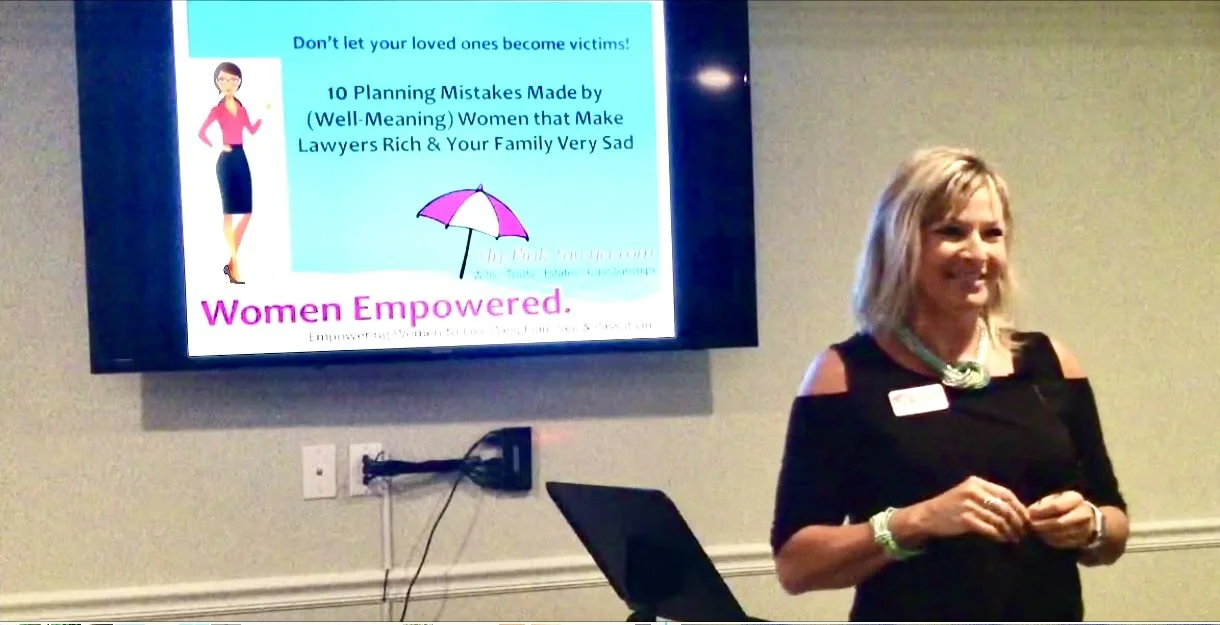
One of the evening workshops I hosted while building My Pink Lawyer®. Years later, I created a personal rule: no evening engagements. Not because there was anything wrong with speaking. Not because I wasn't committed to my business. But because I realized I was designing my business around work instead of designing it around the life I wanted to live.
At the time, I regularly hosted evening workshops, attended networking events, and guest spoke for various organizations. Eventually, I made a different decision. I created a personal rule: no evening engagements.
Not because speaking wasn't valuable. It absolutely was.
But because I realized I had the power to decide how I wanted my business to fit into my life—not the other way around.
I had spent my entire adult life operating from the assumption that work was the fixed object and everything else had to fit around it.
Family.
Exercise.
Vacations.
Friends.
Rest.
The things that made life meaningful got whatever time remained after work's needs had been satisfied.
Looking back, I realize I wasn't struggling with work-life balance.
I was struggling with an unconscious assumption.
The assumption that success required sacrifice.
Not hard work.
Not discipline.
Not delayed gratification.
Sacrifice.
Specifically, the belief that if I wanted a successful law firm, something important in my personal life would inevitably have to suffer.
My family.
My health.
My peace of mind.
My presence.
Many women law firm owners carry this same belief.
They don't necessarily say it out loud.
But it shows up in how they spend their days.
Work gets scheduled first.
Everything else gets squeezed in around the edges.
The irony is that most of us became business owners because we wanted more freedom, flexibility, and autonomy over our lives.
Yet somewhere along the way, many of us accidentally build businesses that dictate our lives rather than support them.
What I've come to believe is that work-life balance isn't really a time management problem.
It's a life design problem.
Nobody gets to decide your priorities except you.
There is no universal rule that says work must always come first.
There is no rule that says a successful law firm owner must be available 24/7.
There is no rule that says you have to sacrifice your marriage, your health, your hobbies, your family relationships, or your peace of mind in exchange for business success.
There are certainly tradeoffs in life.
But many of the tradeoffs we experience are not inevitable. They are the result of choices we've made so many times that they begin to feel like facts.
One of the greatest gifts of adulthood is realizing there are far fewer rules than we think.
We tell ourselves we have to work these hours.
We have to answer every email.
We have to be available all the time.
We have to structure our lives a certain way.
Most of the time, those aren't rules.
They're choices.
And every choice is a reflection of a priority.
Whether we realize it or not, every calendar is a design.
Every life is a design.
The question isn't whether you're designing yours.
The question is whether you're doing it intentionally.
One client recently told me:
"The biggest change has been reclaiming my time and taking back control of my schedule. For anyone who wants to create a business that supports their life—instead of a life that revolves entirely around their business—this work is incredibly valuable." Lauren Merritt, Esq., Florida Probate & Guardianship Attorney
That's exactly why I believe the most important business decision we make isn't how we structure our calendar.
It's deciding what kind of life we're building the business to support.
If you're a woman law firm owner who feels like you've built a successful practice but still find yourself wondering why life feels harder, heavier, or less fulfilling than you expected, it may not be a time management problem at all.
It may be worth exploring the hidden assumptions, patterns, and priorities that are shaping how you experience both your business and your life.
That's exactly what we do inside the Identity OS Framework™.
If you'd like to explore whether we're a fit to work together, I invite you to schedule a 15-Minute Private Exploratory Conversation.
You can learn more about my approach here:
